How to open a dollar account in Kenya: bank or digital
Short answer
- There are two kinds of dollar account in Kenya: a US dollar (USD) account at a Kenyan bank, and US account details in an app.
- A Kenyan bank USD account suits cash, local payments and a deposit you can visit a branch for. Banks usually ask for your ID and Kenya Revenue Authority (KRA) PIN.
- US account details suit clients and employers who pay by US bank transfer, including freelance platforms such as Upwork.
- App balances are usually held as digital dollars, not as a bank deposit, and cannot always be paid out to M-PESA or a Kenyan bank.
- Many freelancers use both: US details to get paid, a Kenyan account to spend.
Compare a US dollar account at a Kenyan bank with US account details in an app: documents, costs, who can pay you, and how to get your money out.
Two things people mean by a dollar account
When people in Kenya search for a dollar account, they usually need one of two things.
- A US dollar (USD) account at a Kenyan bank. Your money sits at the bank in dollars instead of Kenyan shillings (KES). You can withdraw cash at a branch and pay locally.
- US account details in an app. You get a US routing number and account number in your name. A client or employer in the US pays them like any US bank account.
Ask one question first: how will the money arrive? If the payer is a Kenyan or international bank, a local USD account is enough. If the payer can only pay a US bank account, as many platforms and US companies do, you need US details.
Option 1: a USD account at a Kenyan bank
Most large Kenyan banks offer a USD current or savings account. Requirements differ by bank, so here are two published examples.
| Equity Bank | Kenya Commercial Bank (KCB) | |
|---|---|---|
| Account | Current account, can run in KES, USD, EUR or GBP | Currency account in USD and other currencies, for existing customers |
| Documents | Original ID and KRA PIN | Not listed on the product page |
| Minimum balance | No minimum operating balance | Not listed on the product page |
| Monthly cost | No monthly or maintenance fees | US$5 a month below a US$1,000 balance |
| Incoming international transfers | Charged by tariff | Flat fee per transfer |
| How to open | At a branch with the application form | Open to KCB customers; process not listed |
A bank USD account is a deposit under that bank's terms. It is the right tool when you need cash dollars, a local card, or a statement from a Kenyan bank.
The trade-off: a client abroad has to send an international wire, which costs them more and takes longer than a domestic US transfer. Your bank may also charge to receive it.
Option 2: US account details in an app
Several apps give Kenyan residents US account details through a US banking partner after an identity check. The payer sees a normal US bank account, so they can pay by Automated Clearing House (ACH), domestic wire or FedNow.
This suits:
- Freelancers paid through platforms that withdraw to a US bank account, such as Upwork.
- Remote workers whose US employer runs payroll by ACH.
- Anyone whose client refuses to send international wires.
Check two things before you sign up. First, what the balance is held in: many apps convert incoming dollars into digital dollars, such as USDC, which is not a bank deposit. Second, where you can send the money next: some apps cannot pay out to M-PESA or a Kenyan bank.
Which one fits you
| You need to | Better fit |
|---|---|
| Get paid by Upwork or a US client | US account details |
| Withdraw cash dollars in Kenya | Kenyan bank USD account |
| Pay rent or bills in Kenya | Kenyan bank account |
| Hold dollars while you wait to spend | Either; check fees and what the balance is held in |
| Receive digital dollars (USDT or USDC) | A wallet that supports the same network |
How to do it with Jazari
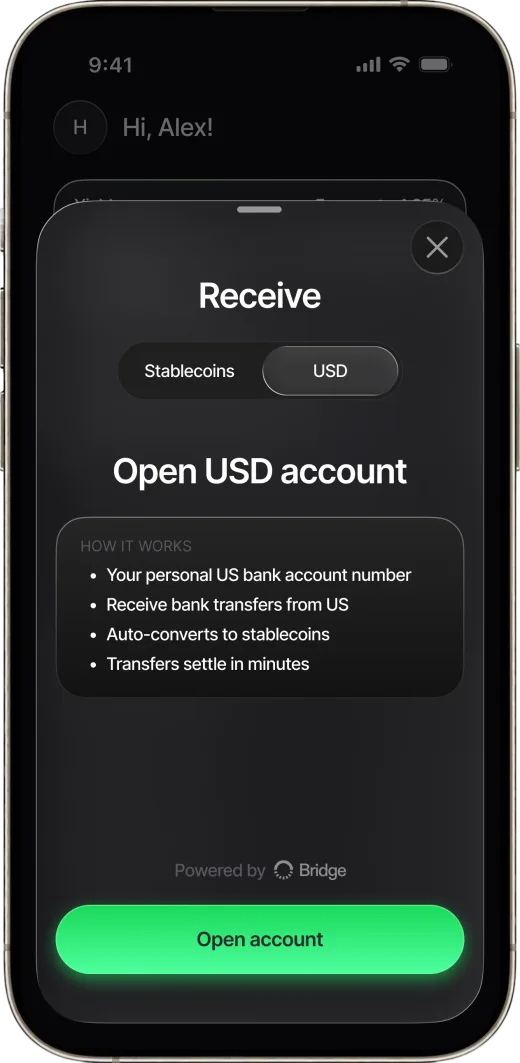
Jazari One gives eligible Kenyan residents US account details in their name through its US banking partner. There is no Jazari fee to open the account, no monthly fee, and no Jazari fee to receive by ACH, wire or FedNow.
- Download Jazari One and create a profile with your phone number or email.
- Enter your address, citizenship and tax residency, then verify your identity with your ID document and a selfie.
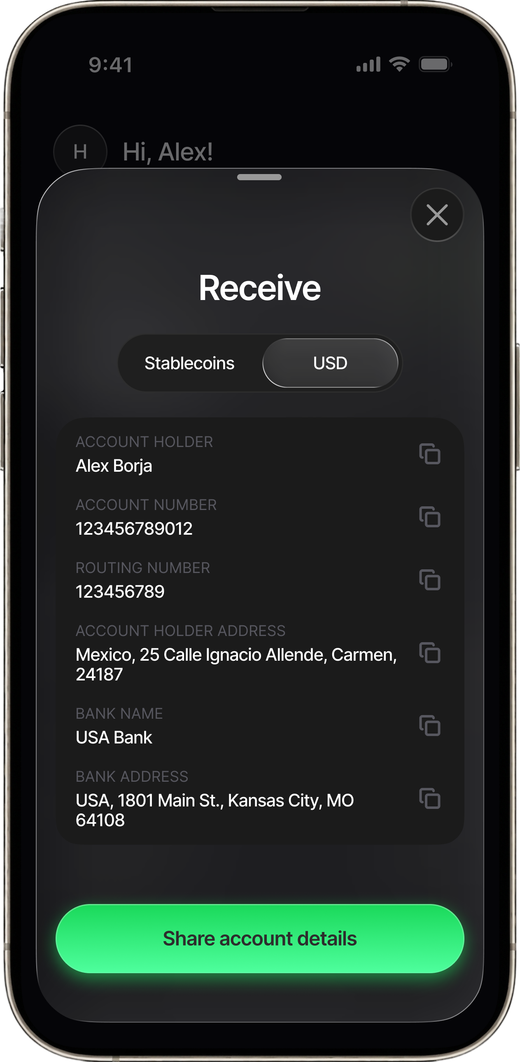
- Once approved, open Receive and copy your routing number and account number.
- Add them as a US bank account on Upwork or give them to your employer. Use your name exactly as it appears in the app.
- Incoming dollars show as a dollar balance, held as USDC. Send them to a wallet or to a bank account in a supported country. Payouts to M-PESA and Kenyan banks are not available.
Common mistakes
- Mixing up the two account types. A Kenyan bank USD account number cannot receive a US ACH payment.
- A name mismatch. Platforms and banks can reject a payment when the account name differs from your profile.
- Sharing details before verification. Wait until the app shows your details as active.
- Expecting M-PESA access. Confirm where you can move the money before your first payment arrives.
Frequently asked questions
Do I need a KRA PIN to open a dollar account in Kenya?
At a Kenyan bank, usually yes. Equity Bank, for example, asks for an original ID and your KRA PIN. App sign-ups use their own identity checks, which do not depend on a Kenyan bank checklist.
Can I receive Upwork payments in a dollar account in Kenya?
Yes, if the account gives you details Upwork can pay. US account details in your name work as a US bank account for platform withdrawals. A Kenyan bank USD account receives an international wire instead, with the bank's incoming fees.
Can I move dollars from an app account to M-PESA?
Only if the app lists M-PESA as a destination for you. Jazari One does not pay out to M-PESA or Kenyan banks today.
Is a dollar balance in an app the same as a bank deposit?
No. Ask what the balance is held in. With Jazari One, incoming dollars are held as digital dollars (USDC), which is not a bank deposit and is not insured.